
What are implants?
The closest thing to a natural tooth
A dental implant is a titanium post placed in the jawbone where a tooth root once existed. Over several months the implant fuses with the bone through a biological process called osseointegration, creating an anchor as strong as natural bone.
Once integrated, a custom porcelain crown is attached, shaped and shaded to blend with your surrounding teeth. The result is indistinguishable from a natural tooth in appearance and function.
Unlike bridges or dentures, implants preserve the jawbone, prevent adjacent teeth from shifting, and require no alterations to surrounding healthy teeth. With proper care they can last a lifetime.

Dental ImplantsRecommended
✓Preserves jawbone density
✓Permanent, can last a lifetime
✓Functions like a natural tooth
✓No adhesives or removal
✓No impact on adjacent teeth
Traditional Dentures
—Bone loss continues over time
—Replacement every 5–8 years
—Slippage and discomfort common
—Adhesives or clasps required
—Bridges affect adjacent teeth
The process
Your implant journey
The implant process is staged deliberately. Each step is planned around how your own bone and tissue are healing, not a fixed calendar.
Consultation & 3D imaging
A comprehensive assessment including digital X-rays evaluates bone density, anatomy and candidacy. You leave with a written treatment plan, transparent costs and a realistic timeline.
Implant placement
The titanium post is placed in the jawbone under local anesthetic. IV sedation is available with Dr. Fisk for patients who would rather sleep through it.
Osseointegration
Over roughly three to six months the implant fuses with the surrounding bone, creating a permanent foundation as strong as a natural tooth root. You feel nothing during this stage.
Custom crown placement
A porcelain crown, matched to your surrounding teeth in shade, shape and size, is attached to the implant and your restoration is complete.
Your options
One tooth, several teeth, or an entire arch
Implants are not a single procedure. The same technology solves very different problems, and the right approach depends on how many teeth are missing and what condition the surrounding bone and gums are in.
A single tooth
One implant, one crown. The neighboring teeth are never touched, which is the significant advantage over a traditional bridge — a bridge requires the healthy teeth on either side of the gap to be filed down. A single implant stands on its own and is brushed and flossed like any other tooth.
Several teeth
When several teeth are missing in a row, you rarely need one implant per tooth. Two well-placed implants can support a fixed bridge spanning three or four teeth, keeping treatment time and cost proportionate while still anchoring everything to bone.
A full arch
An entire upper or lower arch can be restored on as few as four to six implants supporting a fixed set of teeth. Nothing rests on the gums, nothing shifts while eating, and there is no adhesive.
Real results
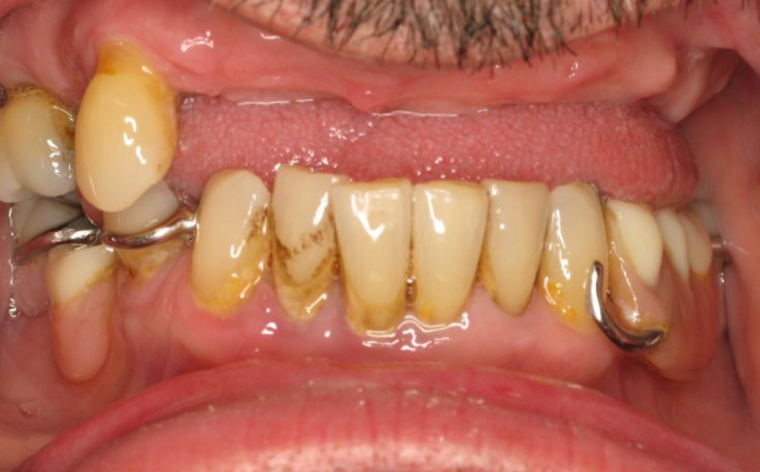
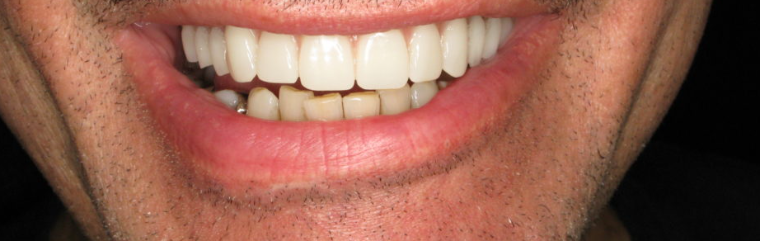
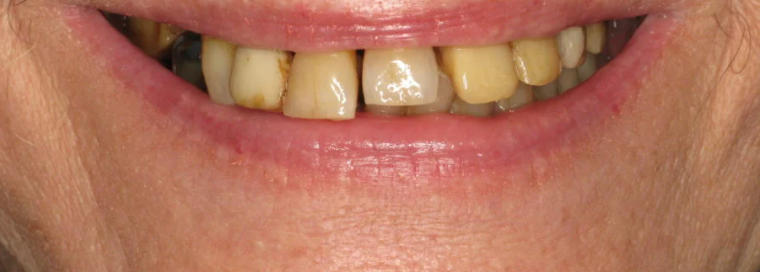
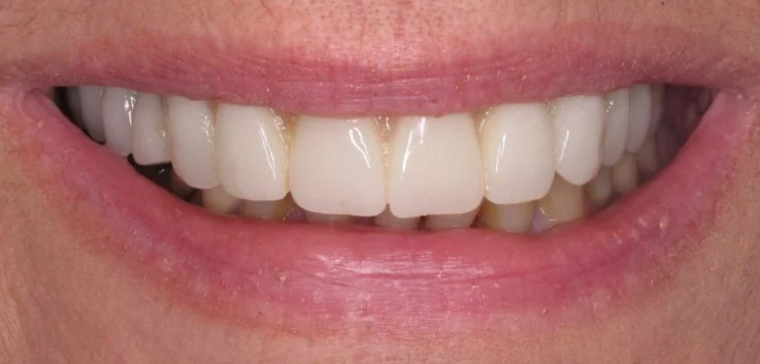
Before and after
Bone & candidacy
Told you don't have enough bone?
It is one of the most common reasons patients are turned away elsewhere, and it is far less often a dead end than people are led to believe. When a tooth is lost, the jawbone that held its root begins to resorb because nothing is stimulating it any longer.
A bone graft rebuilds that foundation. Graft material is placed where the bone has receded and, over a period of months, your body replaces it with your own new bone. For upper back teeth, a sinus lift raises the sinus floor to create the height an implant needs.
Both are routine procedures. They add time, which is the honest trade-off, but they open the door for patients who were told implants were not an option. A 3D scan shows exactly how much bone is present and where.
What we look at
Bone volume & density
A 3D cone beam scan measures the height and width of bone at the exact site, and whether a graft is needed before placement.
Gum health
Active gum disease is treated first. Implants can develop the same inflammation around them that natural teeth do, so healthy tissue comes before anything else.
General health & habits
Uncontrolled diabetes, and smoking in particular, slow healing and raise the risk of failure. Neither automatically rules you out, but both change how we plan the case.
Bite & opposing teeth
How your teeth meet determines the forces an implant absorbs for decades. Grinding or an uneven bite is addressed as part of the plan, not after the fact.
Recovery
What healing actually feels like
Most patients tell us afterward that they had braced for something far worse. Placement is done under local anesthetic, and recovery is generally described as milder than having a tooth pulled.
The first 48 hours
Expect some swelling and tenderness, usually peaking on the second day. Over-the-counter pain relief is enough for most patients. Cold compresses help and soft foods make the first days easier.
The first two weeks
Soreness fades steadily. You keep the area clean with gentle rinsing and careful brushing around, not directly on, the site. Avoiding smoking during this window matters more than almost anything else you can control.
Osseointegration
The quiet part. Over three to six months, bone grows into the surface of the titanium post and locks it in place. In many cases a temporary tooth bridges the gap so you are never without something in the space.
Living with it
Brush twice daily, floss around it, keep your checkups. Implants cannot decay, but the gum and bone supporting them still need looking after. Patients who maintain them well often keep them for decades.
FAQ
Implant questions, answered
Am I a candidate for dental implants?
Most healthy adults with adequate bone density are excellent candidates. Uncontrolled diabetes, heavy smoking or insufficient bone may require additional evaluation or preparatory procedures. A consultation determines your specific candidacy.
Is the procedure painful?
Placement is performed under local anesthetic and most patients report significantly less discomfort than anticipated. IV sedation is available. Post-operative soreness is typically managed with over-the-counter pain medication for a few days.
How long does treatment take?
From placement to final crown is usually three to six months, most of which is healing time. If a graft is needed, add several months. A temporary tooth can fill the gap throughout.
How long do implants last?
With good hygiene and regular checkups, implants frequently last decades. The post itself cannot decay; the gum and bone around it still need care.
Have a question that isn't here? Call 770-995-0538 and we'll answer it directly.
Real results
Implant cases, before and after
Drag the slider through our implant cases and see the difference for yourself. Actual patients; individual results vary.
Other treatments
Explore the rest of what we do
Proud Members & Affiliations
Proud members


Visit us
Find us on Old Norcross Road
Address
747 Old Norcross Rd
Lawrenceville, GA 30046
Free parking outside the office.
Call
770-995-0538Hours
Monday–Thursday, 8:00am–5:00pm
Friday–Sunday, closed